Why Most Indian Ecommerce Websites Fail to Convert (And How to Fix It)
Discover why most Indian ecommerce websites fail to convert visitors into buyers and proven CRO fixes to increase sales and revenue.
Introduction
India has no shortage of ecommerce traffic. Brands invest heavily in ads, influencers, SEO, and marketplaces. Yet most Indian ecommerce websites struggle to convert visitors into paying customers.
Traffic is not the problem. Conversion is.
Whether you are a D2C startup, an established ecommerce brand, or a global company selling in India, the reasons for low conversion rates are surprisingly consistent. And more importantly, they are fixable.
This guide breaks down why most Indian ecommerce websites fail to convert and provides practical, high-impact fixes that actually work.
What Is a Good Ecommerce Conversion Rate in India?
A good ecommerce conversion rate in India typically ranges between 1% and 3%, depending on the category, price point, and traffic quality.
Many Indian ecommerce websites convert below 1% due to poor user experience, lack of trust, slow performance, and unclear value propositions.
The Core Problem: Traffic Is Growing, Trust Is Not
Indian ecommerce brands often focus aggressively on:
But conversion happens after the click.
Indian consumers are cautious buyers. They compare. They hesitate. They abandon carts quickly if anything feels unclear or risky.
Top Reasons Why Indian Ecommerce Websites Fail to Convert
1. Weak or Confusing Value Proposition
Most Indian ecommerce websites fail to clearly answer one simple question:
Why should I buy this from you and not somewhere else?
Common issues include:
How to Fix It
Clarity beats creativity in conversion.
2. Poor Mobile Experience (Biggest Conversion Killer)
Over 80% of Indian ecommerce traffic comes from mobile. Yet many websites are still designed desktop-first.
Common mobile issues:
How to Fix It
If your site feels heavy on a low-end phone, conversion will drop.
3. Lack of Trust Signals (Critical in India)
Indian shoppers do not trust easily, especially on non-marketplace websites.
Missing trust elements include:
How to Fix It
Trust is not optional in Indian ecommerce.
4. Overcomplicated Checkout Process
Many Indian ecommerce websites lose customers at checkout.
Common checkout mistakes:
How to Fix It
Checkout should feel effortless, not exhausting.
5. Slow Website Speed and Technical Issues
Speed directly impacts conversion.
If your site takes more than 3 seconds to load, users leave.
Indian traffic includes:
How to Fix It
Use tools like Google Analytics and Hotjar to identify drop-off points.
6. Poor Product Pages That Do Not Sell
Most product pages in India focus on features, not buying confidence.
Common problems:
How to Fix It
Your product page should remove doubt, not create it.
Why Do Indian Users Abandon Carts?
Why Is Cart Abandonment High in India?
Cart abandonment is high in India due to:
Reducing friction and increasing transparency significantly improves conversions.
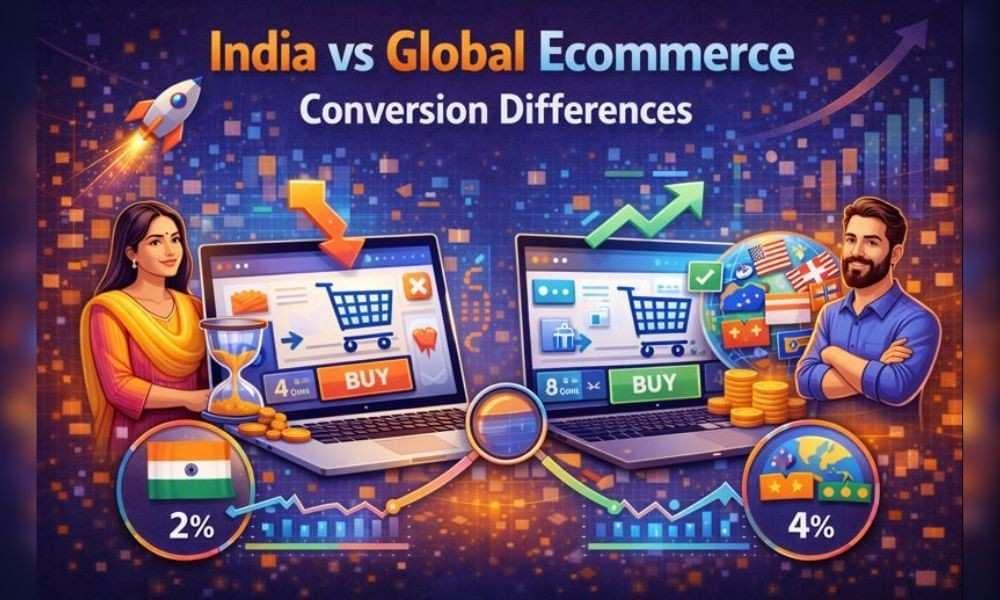
India vs Global Ecommerce Conversion Differences

How Indian Ecommerce Behavior Is Different
| Factor | India | US / Europe |
|---|---|---|
| Trust Level | Lower initially | Higher |
| COD Preference | Very high | Low |
| Mobile Usage | Extremely high | High |
| Price Sensitivity | Medium | Medium–High |
| Brand Loyalty | Builds slowly | Faster |
Indian ecommerce requires extra reassurance at every step.
High-Impact CRO Fixes That Work in India
Conversion Fix Checklist
Small changes often deliver big gains.
Can Better Design Alone Improve Conversion?
Is Website Design Enough to Increase Ecommerce Conversion?
No. Design helps, but conversion improves only when:
Conversion is a business problem, not just a design problem.
Data-Driven CRO: What Indian Brands Should Track
Key metrics to monitor:
Tools like analytics and heatmaps reveal where users hesitate.
Common CRO Mistakes Indian Brands Make
CRO is continuous, not a one-time task.
Global Brands Selling in India: What to Fix First
International brands must:
What converts in the US often fails in India without localization.
The Bigger Picture: Conversion Is a Growth Multiplier
Improving conversion rate:
A 0.5% increase in conversion often delivers more growth than doubling ad spend.
Final Thoughts
Most Indian ecommerce websites fail to convert not because of low traffic, but because of poor user experience, weak trust signals, and unclear communication.
The good news is that conversion problems are solvable.
Brands that focus on clarity, trust, speed, and simplicity consistently outperform those chasing traffic alone.
Fix the experience. Conversion will follow.
Frequently Asked Questions (FAQs)
Why do most Indian ecommerce websites have low conversion rates?
Due to poor mobile UX, lack of trust signals, slow speed, and complicated checkout processes.
What is the average ecommerce conversion rate in India?
Typically between 1% and 3%, depending on category and traffic quality.
Does COD really improve conversion in India?
Yes. COD significantly improves trust and conversion, especially for new brands.
How long does CRO take to show results?
Small CRO changes can show impact within weeks if traffic volume is sufficient.